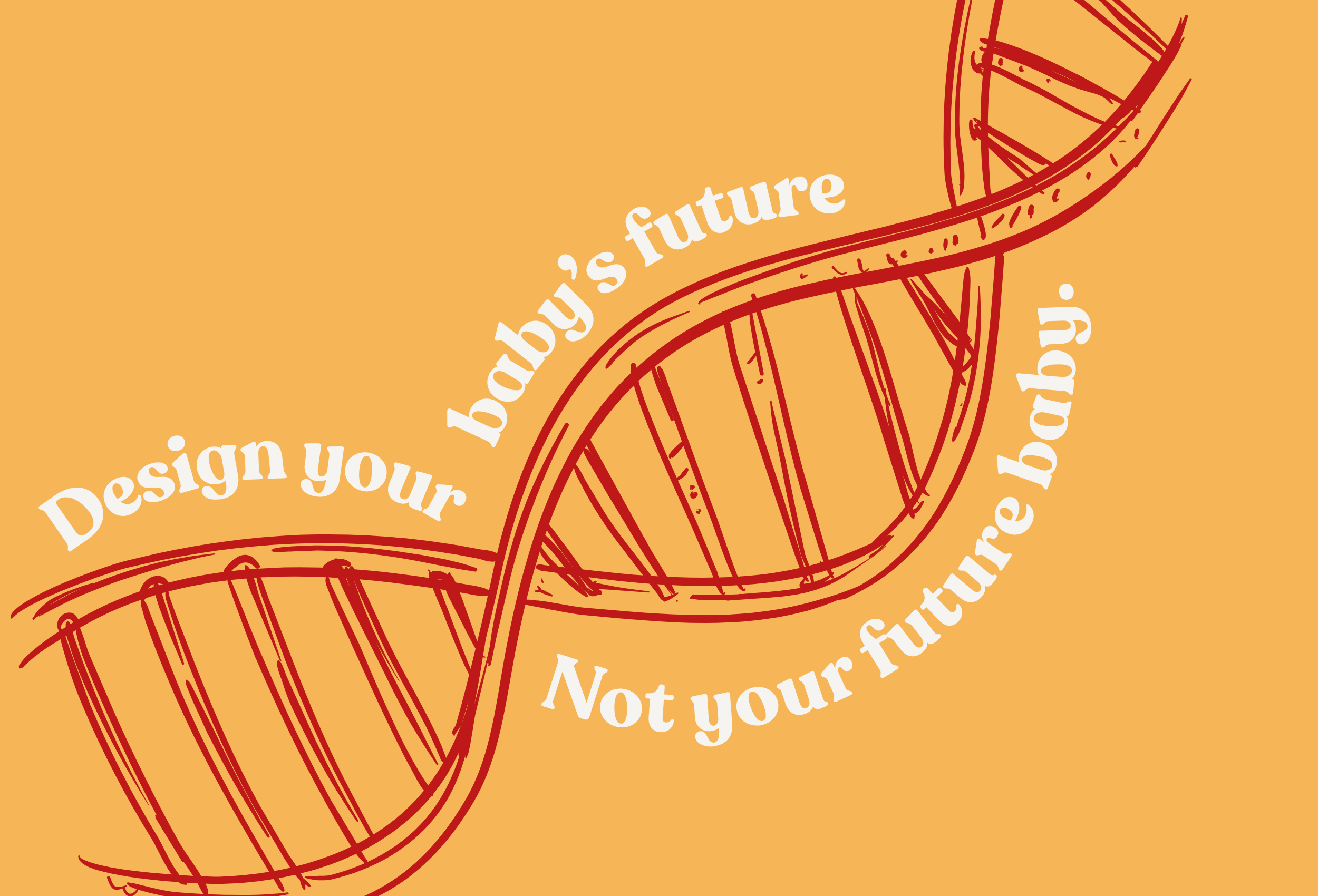
Whether you’re aware of certain genetic conditions in your family line or not, genetic screenings may end up playing a larger role in your family planning than you’d think.
A New Era of Family Planning
When that double line appears on your pregnancy test, you’re immediately riffling through the possibilities of your future: potential name choices, what kind of parent you will be, and what role your partner/family will play, will all be on your mind.
But that growing ball of cells has already made decisions. It has a string of traits — health traits, physical traits, emotional traits — that have been predetermined not with your input, but with your family’s genetic makeup.
Of course, any attempting or expecting parent wants a healthy child. But thanks to your family history, some pregnancies are at an increased risk for genetic disorders and other health complications. These conditions can’t be prevented by would-be parents crossing their fingers. Sometimes, they call for something more invasive.
Now there are resources. Now there’s reassurance. Now we know more about genetics — and how to manipulate them.
What Genes Are You Wearing?
Genetics is a word that carries the weight of a wide variety of fields, and is, “a big garbage can term [that] covers a lot of things,” says Dr. Brian Cooper of Mid-Iowa Fertility clinic.
Under this large umbrella of genetics is the idea of ‘designer babies’. It’s the idea that you can genetically modify an embryo so that it will possess or lack certain health and physical traits.
“[Designer babies aren’t] really realistic,” Cooper says. “Right now, it’s still pretty much science fiction.”
Cooper warns that we shouldn’t hold our breath for further futuristic DNA-altering technologies any time soon.
“It’s just too difficult,” Cooper says. “There are too many factors at work trying to develop anything in this world. It takes a ton of work, and it’s very expensive, so we’re just not going to dump resources into something like that.”
Many people don’t understand just how complicated editing an embryo’s DNA so it possesses or lacks certain traits would be.
“You’re just not going to design yourself, you know, a six-foot [tall], Amazon woman with green hair and hazel eyes,” Cooper says. “I’m being ridiculous, but — just to get the point across — there isn’t a specific one gene that determines all that. It’s multiple factors.”
Additionally, there are contentious debates over the ethics of editing an embryo’s DNA.
According to PBS, In November of 2018, a Chinese scientist named He Jiankui claimed to have edited the DNA of embryos of twin girls that were born later that month. He was later arrested and imprisoned for three years for violating biomedical ethics regulations. His experiment was called ‘reckless’ by the scientific community, and, to date, there’s no worldwide agreement on whether we should design babies.
The only thing that parents can genetically manipulate is their child’s sex, but Cooper hasn’t come across many parents who are even interested in predetermining that.
“Gender selection has become somewhat more popular,” he says. “It’s not a large percentage of people, by any means, but there is a small percentage of people that may have three boys or three girls, and they want to try one more time for the other gender. That does creep up from time to time.”
What happens more often is something called a pre-implantation genetic diagnosis. The DNA of selected embryos is tested as carriers or harbingers for certain health complications. It has nothing to do with physical traits or appearance.
“With most of [these] cases, people are coming to me knowing that, ‘Hey, this is already in my family, and I sure as heck don’t want to pass it on,’” Cooper says.
The cost of these screenings depends, but is often covered by a patient’s insurance. It’s a very real possibility that almost anyone can partake in genetic screenings — not just the 1 percent. Now many families can ease worries and confront genetic conflicts head-on.
A Little Planning Goes A Long Way
Lucie Fink, a video content creator and lifestyle host based in New York City, took part in a genetic screening recommended by her OB/GYN.
“Both my husband and I have Ashkenazi Jewish descent in our backgrounds and apparently … there are specific genetic disorders that you’re way more likely to be a carrier for,” Fink says.
Though Fink did end up testing positive as a carrier for a genetic condition, it didn’t mean the end to Fink and her husband’s family planning.
“My husband did his screening and he did not carry it, and that means we were totally clear to … conceive naturally, and have a baby,” Fink says.
A little planning goes a long way in establishing a secure foundation to start your family.
“This genetic testing did not take away any excitement for us, because really, the blood test screening was just protocol at my OB/GYN’s office. And because we ended up not being a match [together] for anything, it didn’t end up in us having to do IVF. We were able to just conceive,” Fink says. “It increased the sense of safety, but overall it didn’t change anything about the process.”
Of course, not everyone is so lucky. When a potential issue is discovered during screening, then hopeful parents can stage a genetic intervention. IVF is a genetic safety net. It allows you to bypass certain underlying health conditions. It starts with egg retrieval and a sperm sample. Then these are combined to make a cluster of embryos. Those are then tested for genetic conditions. For parents who are both carriers of a genetic condition, embryos without those markers can be selected, essentially wiping out that potential disease.
Genetic testing isn’t perfect, and there’s no guarantee that a genetic mutation won’t occur in future offspring, but time and resources will go towards advancement in the genetics industry — not designer babies.
“I have an extensive conversation with [my patients] and then let them decide [if they want to participate],” Cooper says. “In an ideal world, if we could do [genetic testing] non-invasively, have it be 100 percent accurate and free, then yeah, everyone should do it. It’s getting closer, but it’s not there.”
Let’s Get Ethical
The genetics industry has often been compared to eugenics, the largely discredited theory that certain physical traits are more desirable than others which has its roots in racism and Nazi Germany.
Genetic intervention is the practice of editing genetic disorders, and is not focused on enhancing any one race or ethnicity. However, many people don’t understand what geneticists actually do, which results in this harmful comparison.
“So, you’re kind of like a nurse?” That’s what Meghan Strenk, a certified genetic counselor at Children’s Mercy Hospital in Kansas City, says people ask her when she describes her work.
Strenk’s work involves much more than interacting with patients. She counsels prospective parents on moving forward when their genetic screening presents a health issue.
“There’s kind of this implicit tension in genetic counseling,” Strenk says. “Because my job is to identify the reason that somebody’s kiddo has some kind of difference, and then talk to the family about the genetic reasons [for] why that happened, options for having more children, and if they want to have more children who don’t have that same condition,” Strenk says.
It’s not easy work. Strenk is walking an ethical tightrope between preventing disease and playing God.
“I do think there are some things that are really severe and life-limiting and devastating, and those are things that would benefit from [genetic] treatment,” Strenk says. “But there is, I think, at some point, a[n ethical] line, and I don’t know where it’s at physically.”
For Dr. Jeremy Garrett, a research associate in bioethics at Children’s Mercy Bioethics Center in Kansas City, bioethics is not designing or augmenting for perfection. It’s an attempt to prevent potentially harmful genetic traits from becoming an issue later in life.
“Do I think there’s a struggle for perfection in bioethics? Not really. I think perfection is a straw man term that critics use to make medical genetics seem unhinged and dystopian,” Garrett says. “In reality, what we’re talking about is often a very localized, targeted type of focus. Like, ‘Can I have a child that doesn’t suffer from this condition?’ This isn’t like, ‘I’m trying to engineer a child who’s the perfect specimen of humanity.’”
As far as Garrett is concerned, that sort of talk is nothing but clickbait.
“People will respond viscerally to [the term designer babies],” Garrett says, “but it really doesn’t do a fair service to the types of decisions that are actually being considered. You’re not designing an entire child from a checklist — which feels kind of creepy.”
Strenk views her genetic counseling role as a provider of information. She is aware of an ethical line, one that has yet to be defined by geneticists, and is up to the prospective parents’ discretion. But let’s be clear: neither she nor Garrett are advocating for eugenic practices. In fact, Garrett identifies the social attitude towards the disability community as what needs reflection, not the work of genetic counselors.
“If you actually talk to [people with disabilities] about their life and their challenges, most of the challenges they cite aren’t because of their condition — whatever degree of genetics makes a contribution to that. It’s mostly about society excluding them,” Garrett says. “It’s really not as much the structural limitations within the body or the functional differences, as much as it is [whether] the world is built in a way that includes you and makes it easier for you to do the things you want to do.”
Back to the Beginning (and Babies)
Whether you’re planning on starting a family immediately or sometime in the next 10 to 100 years, genetic carrier screenings, pre-implantation genetic diagnosis, and IVF could end up playing a larger role in your offspring planning than you might think.
It’s also not too late to think about genetic intervention if you’re already staring at the blue double lines. If something runs in your family that you’re concerned about passing on, talk with a geneticist and take advantage of available genetic testing. Get tested before you start trying to conceive or make an appointment after you find out.
Any kind of genetic testing is an elective procedure. It can weed out potential health complications. If choosing any traits at all goes against your child-rearing morals, don’t opt in. If choosing all of your child’s traits sounds ideal, you’re going to be out of luck. It’s just not a possibility. But you can design their entire nursery from scratch.
Words: Caroline Siebels-Lindquist

No responses yet