How “straight edge” has revolutionized Iowa City’s DIY punk scene.
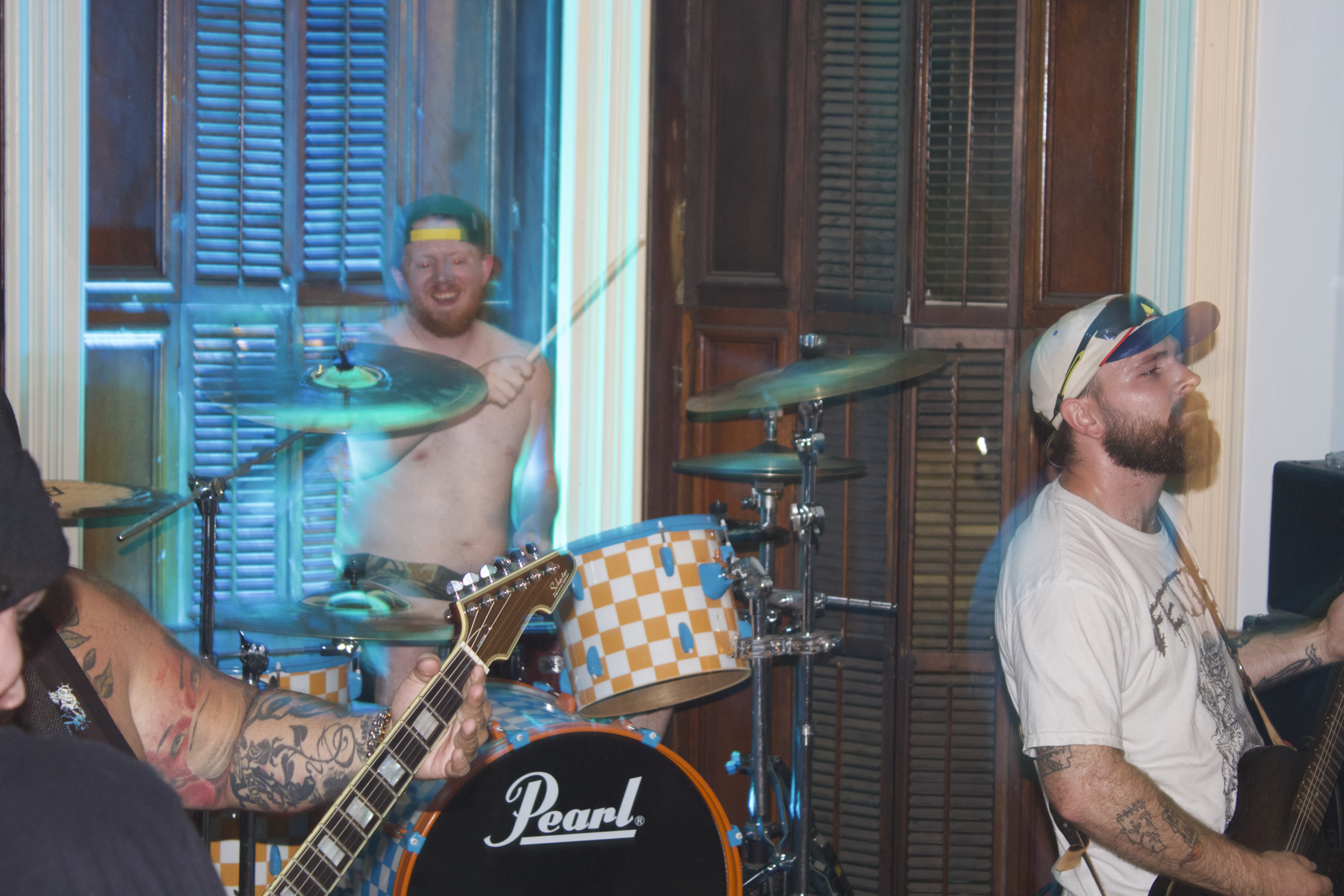
I’ve attended my fair share of hardcore shows. But October 4 marked my first show at the Public Space One (PS1) Close House in Iowa City — it didn’t disappoint. Once a dwelling for the elite, the Close family mansion has been reclaimed by DIY enthusiasts.
As I walked toward the PS1 house, I could hear the music punks affectionately call “noise” bleeding through the walls. Inside, folks had already begun to nod and mosh to the infectious metallic hardcore of touring act Rest Assured, from Indianapolis.
A local greeted us warmly, motioning to a chalkboard advertising a $10 suggested donation. Like most local DIY shows, this concert was “pay what you can.”
Rest Assured commanded the room from the front; PS1’s Victorian-style bay window served as their backdrop. Under the crystal chandelier, concertgoers enjoyed the show in their own ways. Some braved the pit, flailing around with reckless abandon, while others clung to walls and doorways, headbanging all the same.
“What draws me to Iowa City is the kinds of people who come to the shows, it’s all just weirdos — just like me,” says Beatrice Boebel, the lead vocalist of Iowa City local act Angel Without Wings. “There’s nowhere else like it.”
Iowa City’s Punk Scene: Ask a Punk
Punk and hardcore thrive in the heart of Iowa City. One need only ask a punk where the next DIY show is set to happen.
The punk community gathers in droves in basements, garages, and public spaces around town, ever ready to support upcoming performances. Along with the PS1 Close House, common gathering places include the big three punk houses, aptly named Hell, Purgatory, and Paradise.
DIY organizing is a labor of love; shows are hosted by organizers, and their spaces, often basements or living rooms, are shared with their community for a few nights a week. Giving up their space is a small sacrifice for the music and joy that these venues bring to those in the scene.
Oliver Weilein, an Iowa City council representative, scene organizer, and drummer for the hardcore outfit Bootcamp, characterizes Iowa City’s punk scene as eclectic, genre diverse, and ever evolving.
Weilein, who was elected to represent District C last March, blurs the line between grassroots community building and formal civic engagement. He isn’t some suit divorced from the scene. Oliver’s DIY involvement and straight edge ethos inform a political practice rooted in antifascism, mutual-aid, and harm reduction — principles he carries from basement shows to city hall.
Weilein sets Iowa City punk apart from what he dubs the heavier “Capital H” contemporary hardcore punk typical of other Midwestern scenes. Iowa City is known for its mixed bills, which include not only hardcore punk, but punk variations like art punk and noise rock.
“Iowa City has always had this weirdo, artsy vibe to it,” Weilein says. “[We] all share the same space.”
Organizer, vegan straight edge punk, and vocalist for This World is Not Kind, Laela Tesdall, says Iowa City’s scene is far punkier than typical hardcore scenes. Especially compared to those with a straight edge presence.
“Iowa City is more of a punk scene than a hardcore scene,” Tesdall says. “[But] right this second, it does seem that more capital ‘H’ hardcore stuff is starting to pick up.”
What is Straight Edge?
The motivations of the punk scene stretch far beyond an affinity for cramped basements and loud noises. A strong yet unimposing straight edge presence has come to characterize the city’s post-pandemic punk culture.
Tesdall says the term “straight edge” originated from an old Minor Threat song.
Tesdall has claimed the straight edge lifestyle and commits to “abstaining from drugs, alcohol, and tobacco forever, for the rest of my life.”
Tesdall’s commitment stems from her personal battle with addiction. Her sobriety is tightly interlaced with her involvement in the hardcore community.
For Weilein, his straight edge commitment stems from traumatic experiences with alcoholism in his family and a will to maintain personal autonomy. The fear of being unable to help loved ones due to impaired judgment or incapacitation reinforces this choice for him. Weilein credits his ability to travel, build community, and enjoy life’s moments to a frugal lifestyle built around straight edge rhetoric.
“[I] never put myself in a position where I [could] get hurt, addicted, or lose all my money,” Weilein says. “I wholeheartedly believe that I’m only in the place I am today because I am straight edge.”
Mental clarity is a common motivator for straight edge punks.
“[Being straight edge] means having a mind free of substance, that allows you to put yourself into action, to make the world a better place around you,” says Brady Turner, Rest Assured vocalist and vegan straight edge punk. “If I weren’t straight edge, I wouldn’t have the sense of purpose that I do in life.”
There’s been an uptick in interest in attending house shows and participating in scene organizing post-COVID. Many Iowa City punks — and everybody else — have come to realize just how precious social connection is. Many of the shows put on in the pandemic’s wake were spearheaded by straight edge punks like Weilein and Tesdall.
“At that time, those of us who [had been] in the scene for a long time and were booking shows just happened to be straight edge,” Weilein says.
As a result, a younger, more sober crowd felt welcome. Hardcore enthusiasts of all backgrounds took straight edge rhetoric in stride when attending dry shows.
“It used to be [that] people [were] drinking and the show started at 10 p.m.,” Weilein says. “Nowadays, shows are a lot younger in the crowd and are usually over by 10 p.m.”
With straight edge organizers setting the tone, the scene became safer, cleaner, and more inviting.
“People feel comfortable because there isn’t pressure to drink or do drugs or anything that comes along with that,” Weilein says.
Punk Ideology: Beyond Claiming Edge
Straight edge is more nuanced than just adherence to sobriety. These punks aren’t uptight. Despite the strong presence of straight edge within the Iowa City punk scene, straight edge members are clear that the movement isn’t concerned with exclusivity or moral hierarchy.
Though sobriety is an essential choice to straight edge punks, it doesn’t dictate who belongs at house shows or community events. Unity and solidarity remain at its core.
“There’s not a straight edge clique … I hang out with people who like drinking, smoking weed, and [who] [do] drugs,” Weilein says. “It’s just a personal thing; everybody has their own reasons.”
The straight edge movement in Iowa City relies on traditional punk politics of anti-fascism by advocating for self-determination, unity, and financial independence within the community. Weilein hopes to create little pockets of post-capitalist society within Iowa City, using punk organizing as an alternative to the corporate music scene.
The scene’s DIY activism is evident through benefit shows for marginalized groups, including Iowa Mutual Aid, Trans Mutual Aid, and Shelter House. Tesdall also says that veganism and straight edge often go hand in hand as both lifestyles combat a culture of over-consumption.
Weilein and Tesdall reject rhetoric that blames the individual for substance dependency, tracing the problem’s roots to social stress and capitalistic greed. Weilein says if we lived in a society that cared about people over economic greed, he thinks substance problems would be far less common.
Tesdall argues that straight edge punk’s refusal of substances uplifts personal autonomy, away from corporations and hierarchies that profit from addiction, like the alcohol industry that profits from problem drinking. Tesdall adds that drug policy has long been weaponized as a tool of control, citing the Nixon administration’s deliberate demonization of black communities and the anti-war left through media campaigns and heavy drug criminalization.
Weilein knows building a new society in the shell of an old, exploitative one requires solidarity between marginalized communities — a blow to one is an attack on all.
“A lot of people who come to the punk scene are people that are already on the margins of society,” Weilein says. “They know on a personal level what solidarity is and [what] helping each other out means because they struggle, too.
Queer Presence in DIY Scene
The Iowa City punk scene fosters safety for all, but especially for the LGBTQ+ community.
“The queer community is huge in the punk scene,” Weilein says. “It’s a place where no one gives a fuck … they will have your back and will actively help you.”
As far as the LGBTQ+ presence in the scene goes, the numbers speak for themselves.
“One time, I was booking a show for someone, and they wanted to book a specific band because they heard [it had] trans members,” Tesdall says. “And I just told them: this is Iowa City. All the bands have trans members.”
Iowa City punks stand with the queer community, supporting their unique needs. For example, Tesdall says that if a trans kid’s parents aren’t supportive, they might be forced out, and would be welcomed to live in a punk house.
“It’s the type of place that would support [them],” Tesdall says.
For her, personal expression and resistance to bigotry are vital punk sensibilities.
“[The punk scene has a] long history of being a place where people on the margin, misfits, outsiders, are able to come and feel welcome,” Weilein says. “No one judges you for things you can’t control. We have that shared desire for a better world.”
While queerness is innate and punk is chosen, their sense of defiance binds the two together.
“Existing openly as a queer person is an act of rebellion,” Weilein says. “Punk is an act of rebellion against oppression, exploitation, and cruelty in society.”
Tesdall says, historically, punk scenes have been homophobic, but over time, that hate has dwindled. She says that Iowa City’s scene is the type of place where queer people, and their needs, are supported without judgment.
While visiting Iowa City, Turner commended the local punk community for its spirit and unity. The vocalist has experienced scenes across the country, but says Iowa City stands out for the kindness and the solidarity of its members.
Iowa City’s punk scene is a refuge: welcoming, safe, and built by those who value humanity over profit. Here, within a small but self-sustained community, queerness, activism, and creativity thrive.

No responses yet