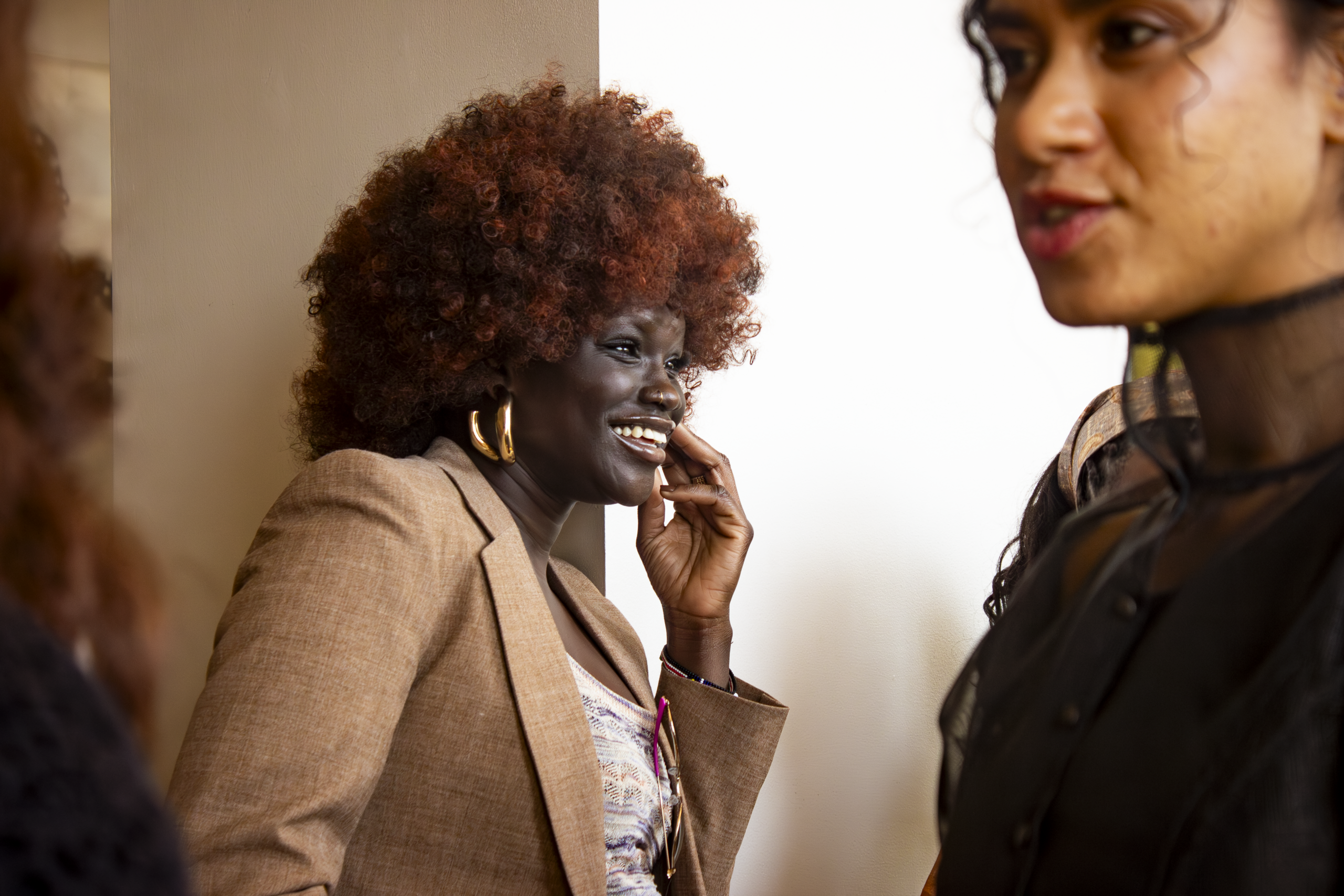
A front-row look at The Fashion Circuit, Des Moines’ hottest fashion endeavor
If a bird pooped on me, I would take the event as a bad omen. And so did Sandrah Nasimiyu at first.
Co-creative directors Nasimiyu and Izzy Kelai are the founders of The Fashion Circuit, a pop-up fashion organization in Des Moines, IA.
Nasimiyu and Kelai were outside of the Des Moines Art Center — the first-ever venue they were exploring for a fashion show — when a bird decided at that moment to unload onto Nasimiyu’s shoulder — and her brand new purse. Naturally, the two made their way inside to clean up after the accident.
“The person at the reception desk said it’s good luck if a bird poops on you,” Nasimiyu says. “It didn’t feel like it at the moment, but we ran with it, and obviously it did [give us] luck because we’re here today.”
What they built was something the city didn’t quite know it needed: a fashion show that sits somewhere between runway, performance, and community gathering. It isn’t just a catwalk; it is a multi-faceted cultural experience. Models dance, designers tell stories, and the audience cheers.
“It should feel like a playground, like you are playing with your creativity,” Nasimiyu says. “Culture is made up of fashion, art, music … they’re all interconnected. So why try to separate them?”
What the F*ck is High Fashion?
In a state most associated with corn and insurance, fashion can feel out of place. But that’s exactly what makes The Fashion Circuit work.
“I think we’re always cultivating our own fashion scene here, which is the beauty of it — we’re not just one thing,” Kelai says. “We’re in the nuance, we’re right in the middle of a lot of things.”
The two met through Swan Project, a local ballet organization. Kelai was dancing; Nasimiyu was working in marketing. They were pulled into the same project and quickly realized something clicked.
Their first collaborative idea was a fashion show. Kelai was immediately on board. From there, the two began building a system.
From the beginning, they knew what they didn’t want.
Traditional fashion spaces come with rigid expectations about body type, presentation, and even personality (America’s Next Top Model, we’re looking at you). There’s a kind of exclusivity that can feel more like a barrier than a standard.
Nasimiyu and Kelai moved in the opposite direction.
Their models are “everyday people” — friends, cousins, neighbors. Aspiring and experienced models find their way in, too. There’s no single look or definition of beauty. All heights, weights, races, and genders belong.
“Fashion is for everyone,” Kelai says. “I want people to feel like they can wear what they want and walk on a runway without feeling like they have to go to New York or Los Angeles,”
Even the runway itself isn’t fixed. Since The Fashion Circuit is a pop-up, their shows are always in a different location. And the walk is whatever the model, designer, or coordinator decides. In one show, dancers performed alongside models. In another, models danced on the runway instead of walking.
“That’s not something you would see in a place that would be considered high fashion,” Nasimiyu says. “I feel the word ‘high fashion’ is a way to block people out — what exactly is the definition of high fashion and who decides what high fashion is?”
That question carries extra weight in Iowa.
“It’s so strange because no one ever thinks of Iowa for fashion,” Nasimiyu says. It feels almost niche to have fashion in Iowa.”
And where fashion did exist in Iowa, it felt limited and redundant, Nasimiyu says.
“It would be the same venue in the same format, and I knew what to expect, even at castings. I knew what kind of models they were looking for,” Nasimiyu says.
Back to the Beginning
The first show was free. It had to be.
It was at Olson-Larsen Galleries in Valley Junction, West Des Moines, IA, on April 18, 2025.
“We invested so much more money into that first show, but because you can’t expect people to pay for something they don’t know … we made it free for the public,” Nasimiyu says.
Kelai hoped for 100 attendees based on social media interactions.
But the turnout was much more than the two had anticipated. Over 500 people were in attendance at the first show at Olson-Larsen Galleries in Valley Junction, West Des Moines.
“It was so packed inside that we got worried that the first department was actually going to get called,” Nasimiyu says.
People were standing, sitting on the floor, and standing on the grass or sidewalk outside, trying to catch a glimpse inside.
“I got upset with some friends because they were late. They were like, ‘We’re sorry, we had to park eight blocks away.’ … Our community really did show up for us that day,” Nasimiyu says.
By the second show, they introduced tickets — unsure if the momentum would hold.
It sold out.
Each show has evolved: new venues, new formats, and new energy. No two shows feel the same. Unpredictability is the point.
Behind the Curtain
What happens on the runway is only part of the story. Behind the scenes, The Fashion Circuit is building something closer to an ecosystem.
“I think fashion can get very cliquey and there’s a hierarchy — [The Fashion Circuit] never feels like that,” says Addy Kaster, back of house production director. “We’re one big family. There’s no side gossip or pitting people against each other.”
Through its fellowship program, young people ages 15 and up are paired with experienced individuals to learn skills and gain real-world advice. Emerging designers create their own collection, participate in casting, fittings, and shows.
“It’s not [a traditional] internship where you’re given base-level work … Your ideas matter. Your thoughts matter,” Nasimiyu says. “We want to hear what you think because it’s going to make the show better. You got selected because you’re a creative genius in your own right.”
Sara Markham was a design fellow last year, but now works on staff as the set design director. She had never made a full collection before, so the fellowship program offered the opportunity to start small and grow with the help of more experienced designers.
“[The fellowship program] opened more doors for me,” Markham says. “Then I got appointed to set design[er].”
Then there’s Pull Up & Stitch, a monthly workshop series rooted in community care. The price of admission is a donation to the local charity of the week. The event gives participants the opportunity to learn how to sew tote bags and other apparel while giving back.
“[The point of Pull Up & Stitch] was just to bring people together to try something new and give back to the community,” says Rachel Gai, who co-runs the Pull Up & Stitch program with Destiny Williams. “I think a lot of people are looking for ways to give back but also [to] see the fruit of that labor.”
The Fashion Circuit also introduced Sunday Socials — open networking events where models, designers, and community members can connect before show day.
There is no longer a definitive line between model and designer versus ordinary people. In an industry defined by competition and stiff beauty standards, The Fashion Circuit leans toward collaboration and diversity.
“There’s so many talented creatives in the Midwest, and it often gets overlooked because people just don’t really think of Iowa as a hub for fashion,” says Trinity Lakose, photography director. “There’s a ton of super-talented and cool people here. [The Fashion Circuit] is giving them a place to thrive and foster community.”
Walking into the room of creatives buzzing around, you are immersed in a friendly frenzy. There is no competition or upturned noses, just a community of people working together.
“I feel like if we wouldn’t feel comfortable walking into a room that we created, then we definitely fucked up somewhere along the way,” Nasimiyu says.
Money Matters
Building something like this comes with realities that passion alone can’t solve.
For their first year, Nasimiyu and Kelai self-funded everything. Their team, despite the long hours, worked on a volunteer basis.
“We did this for our community,” Nasimiyu says. “[But] I do believe you should make money off the things you love. Being starving artists is not cute. It never has been.”
Their goal is sustainability, not just for themselves, but for everyone involved. “[We’re] making sure people get paid so their needs are met and they don’t have to live in survival mode,“ Kelai says. “[If] we can take care of everybody’s needs, they can relax and have more time on their hands to create art from a different [mental] place.”
At the center of it all is the partnership between co-directors.
“I grew to love [Nasimiyu], just as she is. I never felt heard or seen working with someone [else],” Kelai says. “We give each other so much grace and love.”
They describe themselves as friends first. Then, collaborators who fill in each other’s gaps, who communicate through disagreements, and who keep showing up for The Fashion Circuit — and for each other.
The Groove Theory
On May 8, 2026, The Fashion Circuit will host its third show, Groove Theory, at The French Way in Des Moines.
Inspired by the 1970s, the event leans into a decade defined by boldness and self-expression, without replicating it directly. Designers are encouraged to interpret the era in their own way: through color palettes, silhouettes, or upcycled vintage pieces.
“It should feel like if the ‘70s got a chance to exist in 2026,” Nasimiyu says.
The audience is part of the vision, too. Guests are encouraged to dress the theme, becoming part of the immersive experience rather than just watching it.
Where the Runway Ends
For Nasimiyu and Kelai, the runway isn’t fixed to a single definition.
“A sidewalk can be a runway for God’s sake,” Nasimiyu says. “Anything can be.”
Their long-term vision stretches beyond Des Moines: traveling shows, a true “circuit,” with recognition across the Midwest and beyond. They want people from across the country to come to Iowa, not in spite of its location, but because of what is being built here.
When people think of fashion in the Midwest, they say they want The Fashion Circuit to come to mind first.
Words: Liz Rosa

No responses yet